Salespeople Are Poor Data Entry
Run the number for your own team. It is worse than it feels.
Take a fully loaded rep cost of $150,000 per year — conservative for experienced B2B sellers. Forrester tracked 3,031 reps and found the average seller loses nearly two full days every week to administrative work. Two days out of five means roughly 40 percent of that cost is buying administration, not selling.
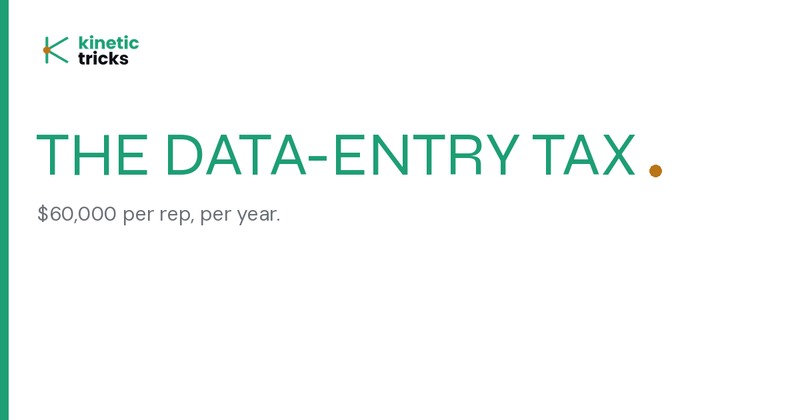
That is $60,000 per rep, per year. A twenty-five-rep organization is spending about $1.5 million a year in sales payroll on record-keeping and internal process. A fifty-rep organization is spending around $3 million. This is payroll you are already spending — the question is what it purchases.
The costs stacked on top
Add the policing cost. Most organizations at this scale carry sales operations headcount whose week is partly consumed by chasing updates, deduplicating records, and reconciling the pipeline before every review.
Add the ritual cost. The weekly forecast cycle pulls managers and reps into preparation and meetings that consume the better part of a selling day across the team — to produce a number that Gartner’s research says fewer than half of leaders trust.
Then add the cost that never appears on a spreadsheet: decisions made on wrong data. Territories planned around stale accounts. Hires justified by pipeline that was not real. Deals lost because the renewal date sat wrong in a field nobody maintained. Gartner estimates poor data quality costs organizations an average of $12.9 million per year — and while that figure skews toward large enterprises, the mid-market version is proportionally brutal. Validity’s research found 44 percent of organizations lose more than 10 percent of annual revenue to low-quality CRM data.
Ten percent of revenue. Set that beside the standard remedy: the hygiene initiative costs selling time, delivers a few weeks of accuracy, and leaves the leak untouched.
The tax is not the cost of doing business. It is the cost of a specific design decision made thirty years ago — one you are free to stop paying.
What the same payroll buys instead
When the execution layer stops being human — capture from calls and email, continuous enrichment, stages moved on evidence — the two days come back as selling days. Reps spend the week where those hours always belonged: with customers. The forecast starts from a true number instead of a negotiated one. And the sales ops team stops policing records and starts doing operations.
The full white paper — Your CRM Sucks: And It’s Not the Software — includes the complete cost breakdown, the task-by-task comparison of the human-fed and autonomous models, and the argument for why every enforcement-based fix fails on schedule. Free download.