
Deployment & data ownership
Your pipeline never leaves your server.
Every deployment is dedicated and runs on infrastructure you control. Not a tenant in our cloud with a region setting — your server, your environment, your keys.
What “self-hosted” means here.
Most business software lives in a shared cloud. Your records sit in a multi-tenant database, and your conversations pass through the vendor’s account with the model provider. That is a reasonable trade for a lot of software.
It is a harder trade when the data is the list of organizations you are selling to, what you know about them, and what they have told you in confidence.
Kinetic Tricks takes the other path. The full stack installs on a server you own. We do not hold a copy.
What gets deployed.
- Scout, Sage, and Aria — the agents, running against your pipeline and your content.
- The Console — the web front door, alongside your inbox.
- The CRM — a full instance, with your contacts, accounts, opportunities, and activity.
- The knowledge base — your product, positioning, and voice, which is what the agents write from.
- Site and lead capture — forms that write straight into your own CRM rather than a vendor’s.
- Scheduling and reporting — social queueing, daily briefs, weekly reports, manager rollup.
Nothing is shared with another customer. There is no pooled database and no cross-tenant index.
You hold the keys
You choose the model. You pay it directly.
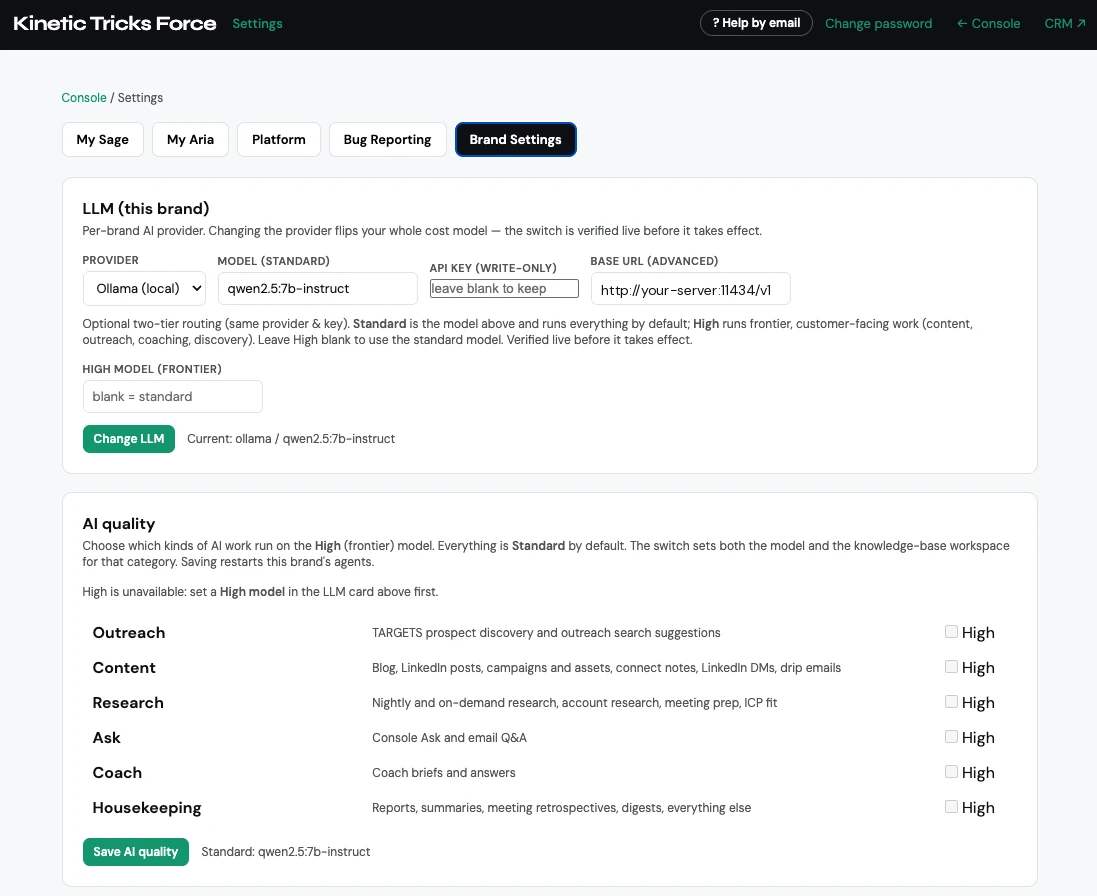
Kinetic Tricks does not resell inference. You supply your own provider credentials — Anthropic, OpenAI, xAI, or a local model through Ollama — and that provider bills you at their rate. We add no markup and bundle nothing that would obscure what the AI actually costs.
Two things follow. You decide which provider sees your data, and you can run entirely on local models if your obligations require it. You can also split the work: a standard model for everyday tasks and a frontier model only for the customer-facing writing.
A meter you can read.
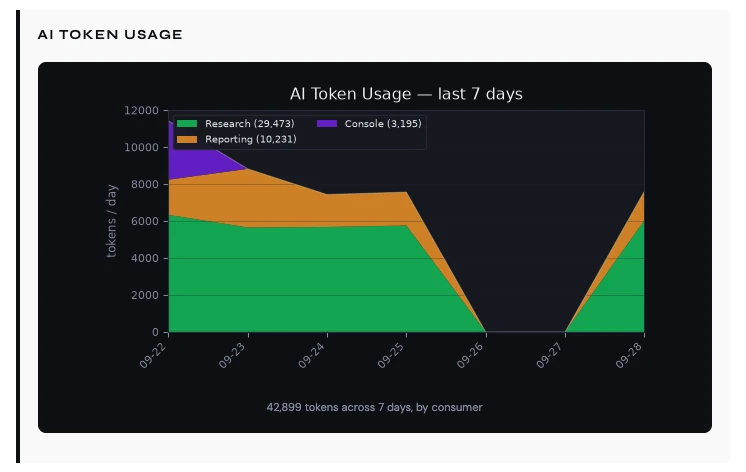
Because the key is yours, so is the meter. Every brief shows what the agents used, by job. A full conference outreach campaign across roughly a thousand contacts ran about $2.40 in tokens.
What it takes to run.
Less than people expect. One sales user running one brand fits comfortably on a modest server under 4 GiB of RAM — the tier most providers price in the low tens of dollars a month. Adding users and brands grows it gradually rather than in steps.
Host it anywhere you already work: your own hardware, your existing cloud account, or a server we help you stand up. If you would rather not manage infrastructure at all, we will host it for you — the deployment is still dedicated, not pooled.
Activation includes the whole setup. It takes about thirty minutes of your time; we do the rest.
Your backups, one click away.
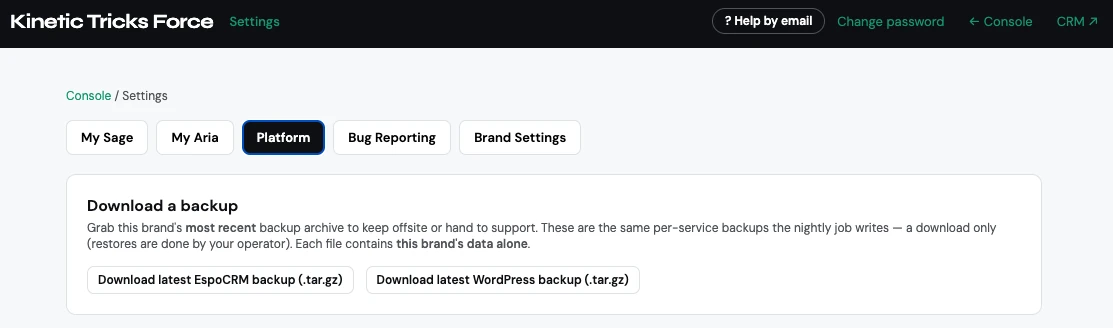
Every night, each service in your deployment writes its own backup. Download the latest CRM or website archive from the Console whenever you want a copy offsite. Each file contains that brand’s data alone.
You can read the source.
Under the evaluation agreement you get source-code visibility. If your team wants to know what the agents do with a contact record before you point them at your pipeline, you can look rather than take our word for it.
That is only possible because the code runs on your server.
The honest limits.
- We don’t hold a compliance certification. What we offer is architectural — your deployment, your keys, your data. If your contracts require a certified vendor, that is a real constraint and we will say so rather than talk around it.
- Self-hosted means you own the server. Uptime and OS patching are yours unless you take managed hosting. Nightly backups are built in; where you keep the copies is your call.
- Model costs are variable. Because you pay the provider directly, your bill moves with your usage. That is the trade for transparency — no flat fee that quietly includes a margin.
Who this matters most to.
Every customer runs it this way. But for some buyers it is the whole reason the conversation happens at all — security and compliance firms whose client data cannot sit in someone else’s cloud, and regulated sellers whose agreements make the question straightforward.
Bring your hard questions.
Where it runs, what touches the model, what happens to your data. Those are the right questions and they have direct answers. Fifteen minutes, no deck.